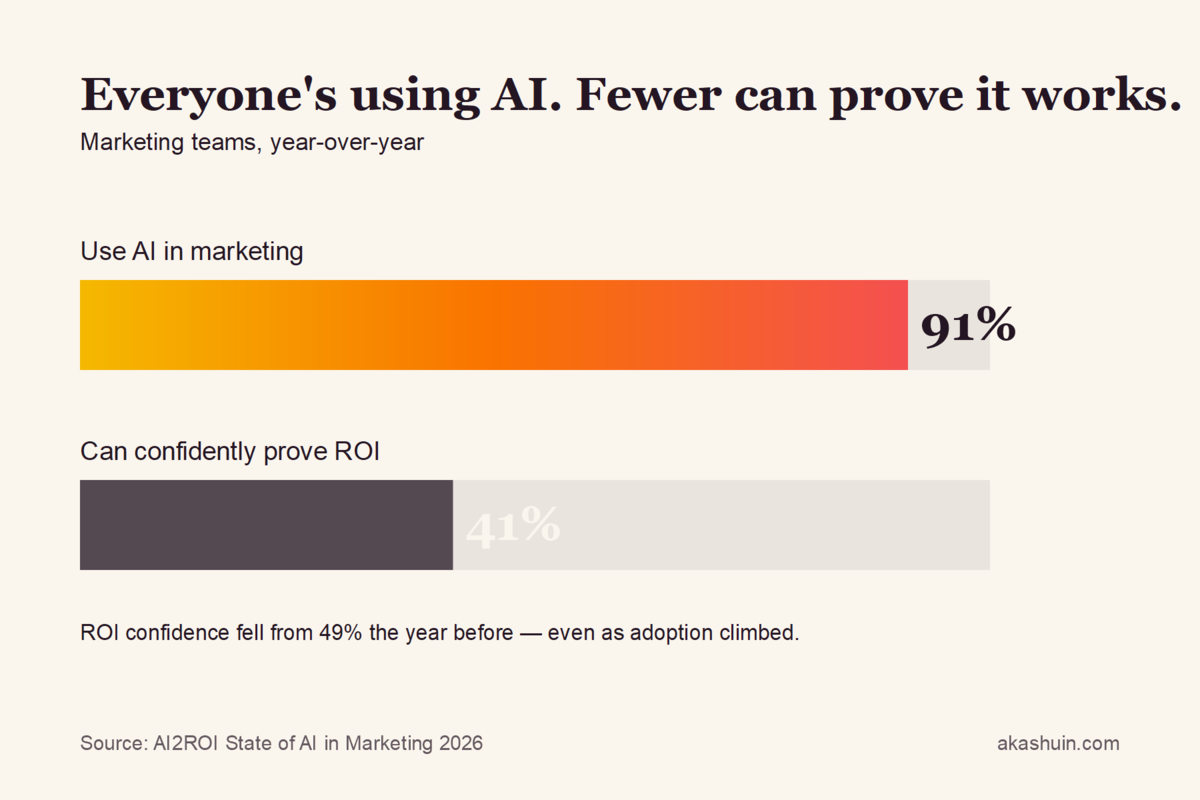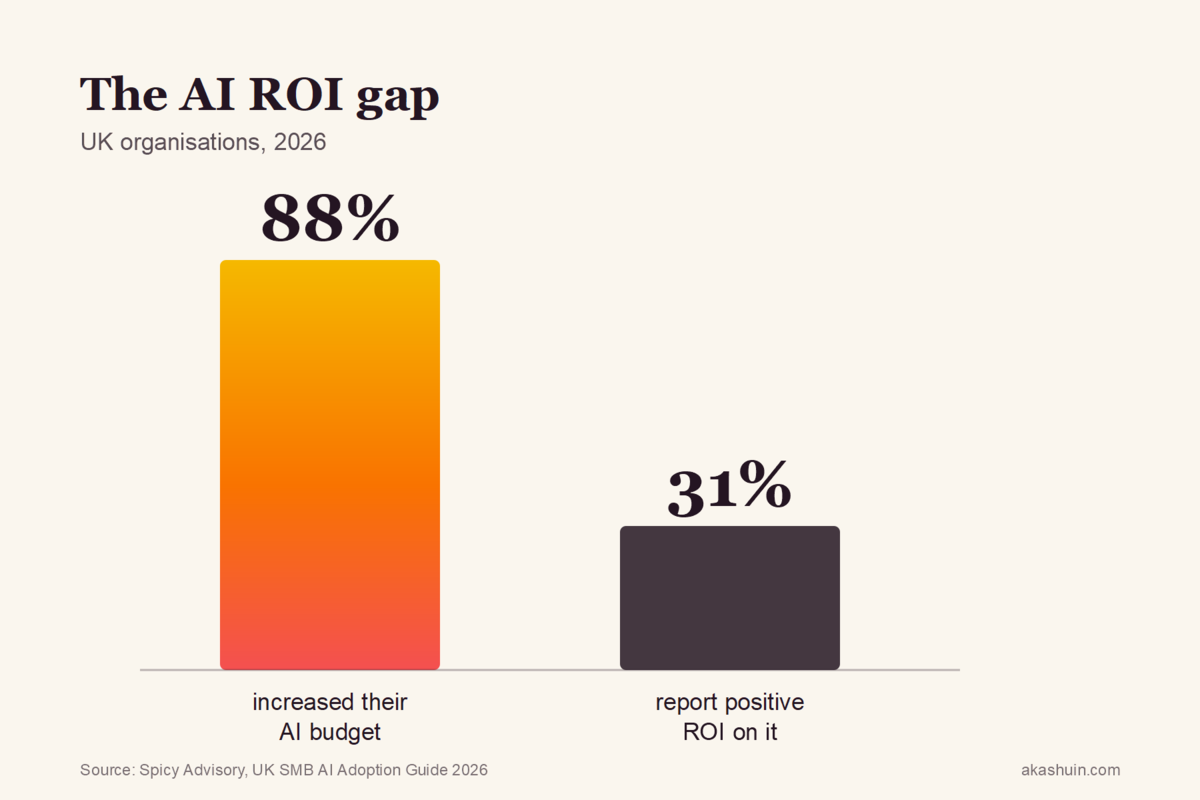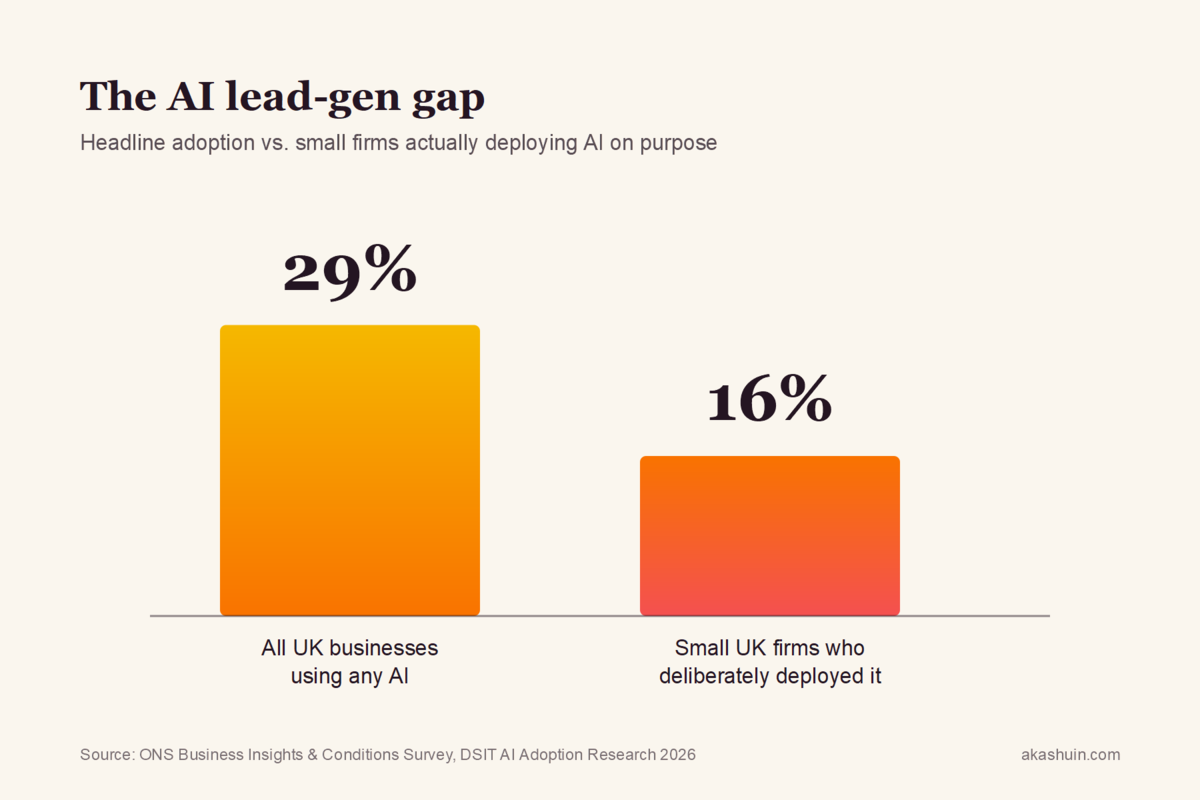
AI lead scoring lifts conversion by roughly 30 percent, according to last year’s vendor benchmark data. Meanwhile only 16 percent of UK small businesses have deliberately deployed any AI technology at all. Those two numbers sitting next to each other tell you most of what you need to know about where the opportunity actually is.
The adoption gap nobody quotes
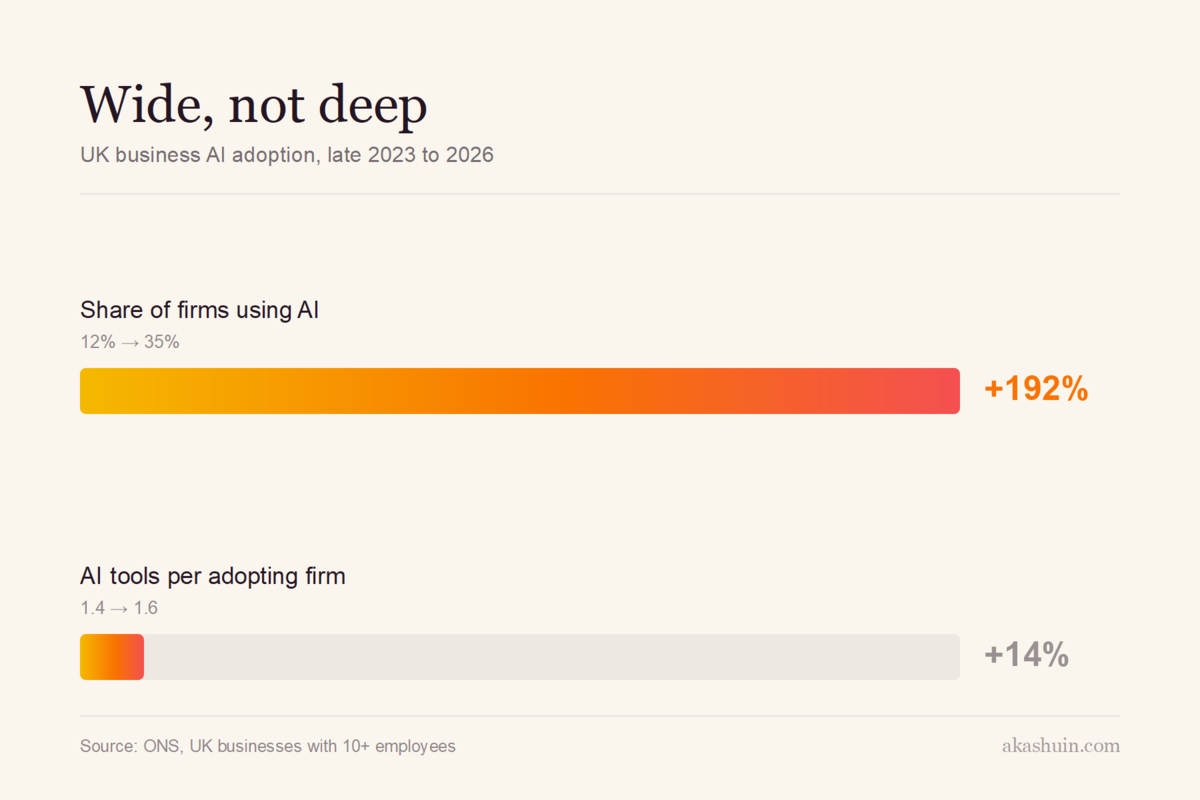
The headline figure everyone repeats is 29 percent: the share of UK businesses now using at least one AI technology, according to the Office for National Statistics’ Business Insights and Conditions Survey run in June 2026, up 8 points on the year before. It sounds like AI has gone mainstream. It has, but only for one size of company. Among businesses with 250 or more staff, adoption sits at 49 percent, up 13 points.
Drop down to the businesses most agencies and service firms actually are, and the picture changes. Research from the Department for Science, Innovation and Technology puts deliberate AI deployment among UK firms with five or more employees at 16 percent, with a further 5 percent saying they have concrete plans to. That’s the real adoption rate for the businesses reading this post, and it’s roughly a third of the enterprise figure.
The interesting part isn’t the gap in adoption. It’s the reason for it. When DSIT asked small businesses why they hadn’t deployed AI, cost came bottom at 23 percent and integration complexity next at 29 percent. Skills came second at 60 percent. The single biggest barrier, at 71 percent, was simply that they hadn’t identified a need for it.
That’s not a tooling problem or a budget problem. It’s a use-case problem. Most small firms have never sat down and mapped a specific, repeatable job in their business onto a specific AI capability. Lead generation is one of the clearest places to do exactly that, because it’s already a repeatable process with a measurable outcome, which makes it easy to prove the case one way or the other.
What an AI lead-gen system actually does
“AI for lead generation” gets used loosely to mean everything from a chatbot widget to a fully autonomous pipeline. The version worth building is the latter: a system that runs the whole sequence without someone manually pushing it through each stage.
A working pipeline typically covers five stages:
- Discovery. Finding companies or contacts that match a defined signal (funding round, hiring pattern, tech stack change, a trigger event) rather than a static list.
- Enrichment. Filling in the contact, company, and context detail that makes personalisation possible instead of generic.
- Scoring. Ranking prospects so a human’s time goes to the ones actually worth it. This is the stage where that roughly 30 percent conversion lift cited in 2025 vendor benchmark data mostly comes from. Scoring doesn’t create leads, it stops good ones getting buried under bad ones.
- Personalised outreach. A first draft that references something specific to the prospect, not a merge-tag template.
- Follow-up. Re-engaging people who didn’t reply the first time, on a schedule, without someone remembering to do it.
None of these stages need to be fully autonomous on day one. The mistake most small firms make isn’t picking the wrong tool, it’s trying to automate all five stages at once, stalling on the integration work, and concluding “AI doesn’t really apply to us.” That’s exactly the 71 percent barrier showing up in practice, not just in a survey.
This is also the point where hiring versus automating stops being a philosophical question. A pipeline like this is genuinely multi-step work: research, judgement calls, drafting, timing, which is what makes it a good candidate for an autonomous agent rather than a single tool bolted onto a spreadsheet. The difference between a chatbot and an agent here is whether the system can carry a prospect from discovery through to a drafted, personalised message without a person moving it along at every step.
Try this: pick one stage, not five
If you run a small firm and want to actually test whether AI helps your pipeline rather than just reading about it, do this over one week:
- Pick your slowest stage, not your favourite one. Time how long each of the five stages above currently takes, from someone opening a list to a message actually going out. Automate the one taking longest first, usually enrichment or follow-up, rarely discovery.
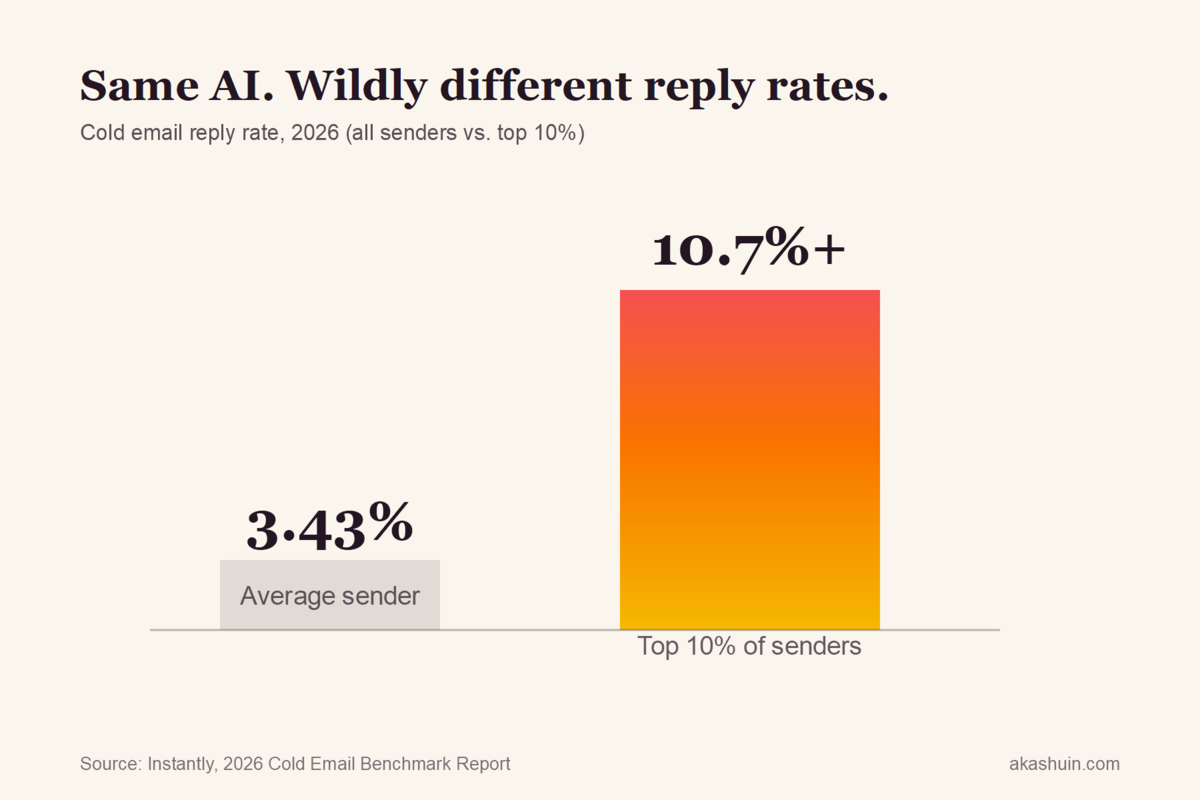
- Measure reply rate, not volume. More leads processed faster means nothing if reply rates fall because personalisation got thinner. Track reply rate for the two weeks before you change anything and the two weeks after. If it drops, the automation made the messages worse, not just faster; fix that before scaling it.
Both of those are things you can do this week with what you already have, before spending anything on new tooling.
The honest version
The case for AI in lead generation isn’t that it will replace the judgement calls. Deciding which prospect is actually worth a call still needs a person who understands the business. It’s that scoring, enrichment, and follow-up are exactly the parts of the job that don’t need judgement, and are also the parts most small teams do worst, because they’re tedious and easy to let slip. Automate those three and the person doing outreach gets to spend their time on the 20 percent of prospects that were always going to close, instead of working evenly through a list where most of it never had a chance.
The 29 percent adoption headline was never really about firms like most of akashuin’s readers. The 16 percent figure is. If you’re going to be one of the businesses that moves from that 16 percent to something higher, lead generation is one of the few places where you can prove the return in weeks, not quarters. If you’d rather have that pipeline built for you than build it stage by stage, that’s what an autonomous agents engagement is for.